
Let’s be clear upfront, voice commerce in India is still highly futuristic. Hardly anyone is asking Alexa or Google Assistant to order groceries today. But if we look westward, the pattern is clear: smart speakers and voice-enabled shopping are growing fast in markets like the US and Europe, where consumers already use voice for reordering essentials. Historically, India lags 3–4 years behind these adoption curves. That means what feels experimental now could be mainstream by the late 2020s. For Q-commerce brands, this creates a unique opportunity: start preparing today while the competitive field is still empty, and reap disproportionate rewards when consumer habits inevitably shift.
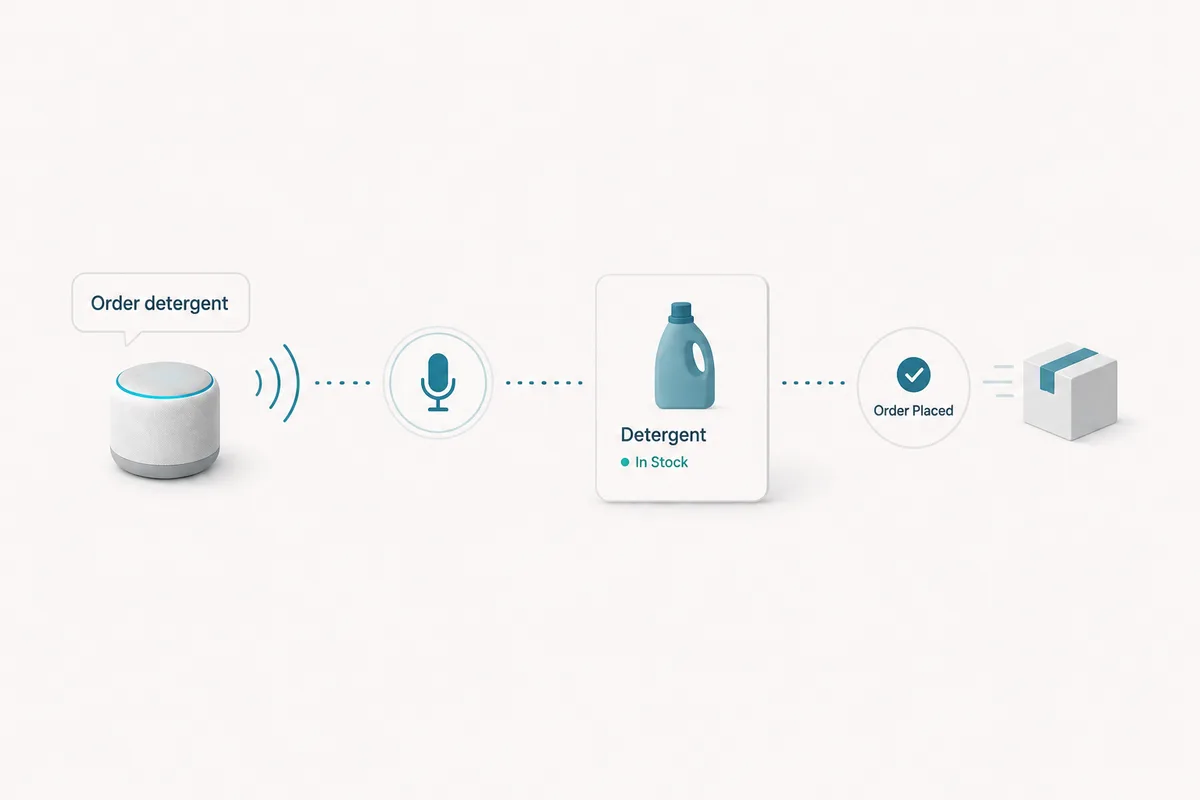
Voice commerce and quick delivery share the same DNA, speed and convenience. Customers don’t open their phones to scroll; they simply say, “Order detergent” or “Get snacks.” But this convergence also exposes major challenges. Voice interfaces can’t show product images or comparisons, which makes discovery harder. Customers default to generic terms, so brand recognition suffers. On the backend, voice ordering requires real-time stock visibility and seamless payment flows, areas where most Indian brands are still underprepared. These may not feel urgent today, but by the time adoption spikes, playing catch-up will be far more expensive.
The Four-Layer Framework for Future Readiness
Layer 1: Voice-First Product Architecture
Customers won’t ask Alexa for “organic cold-pressed extra virgin olive oil 500ml.” They’ll say “cooking oil.” That means brands need to simplify product titles, restructure categories, and optimize for conversational keywords. Even before voice shopping takes off in India, preparing product catalogs this way improves discoverability across platforms like Blinkit and Zepto, where short queries already dominate.
Layer 2: Conversational Commerce Integration
Voice commerce isn’t a funnel, it’s a dialogue. Customers expect assistants to answer questions, suggest substitutes, and handle reorders. Building conversational AI today can strengthen chat and WhatsApp commerce experiences immediately, while also preparing for future voice integrations. The goal is simple: replicate the feel of talking to a neighborhood shopkeeper who knows your preferences.
Layer 3: Platform Integration Strategy
In the West, voice commerce is fragmented across Alexa, Google Assistant, and Siri. In India, regional-language platforms will eventually add to the mix. Each will demand different integrations. Brands that start experimenting with even one platform today will have a learning curve advantage when others catch up. Think of it as rehearsal: the actual show may be a few years away, but the audience will reward those who are ready.
Layer 4: Predictive Voice Commerce
The ultimate future isn’t reactive ordering but predictive fulfillment. Assistants will nudge: “You’re probably low on milk, should I reorder?” While this sounds far-fetched in India right now, the groundwork, predictive analytics, smart subscriptions, and loyalty hooks can be laid today. These tools already boost retention in current app-based commerce and will naturally extend to voice when the time comes.
Competitive Advantage for Early Movers
It’s important to stress again: voice commerce won’t transform Indian Q-commerce tomorrow. But that’s precisely why acting early matters. In Western markets, early adopters benefitted from algorithm preference, stronger partnerships with platforms, and customer habit formation. The same pattern is likely to play out here. Brands that establish even a basic presence in the next 2–3 years will shape consumer defaults when the real wave arrives.
Voice commerce in India isn’t here yet. The adoption will be gradual, and it may feel irrelevant for the next couple of years. But by the time it matters, the winners will already be decided—those who prepared their product catalogs, built conversational AI capabilities, and experimented with platform integrations before the crowd caught on. For Q-commerce brands, the lesson from the West is clear: don’t wait for voice to become mainstream to take it seriously. The future shelf is a spoken one, and early preparation will decide who gets named—and who gets forgotten.