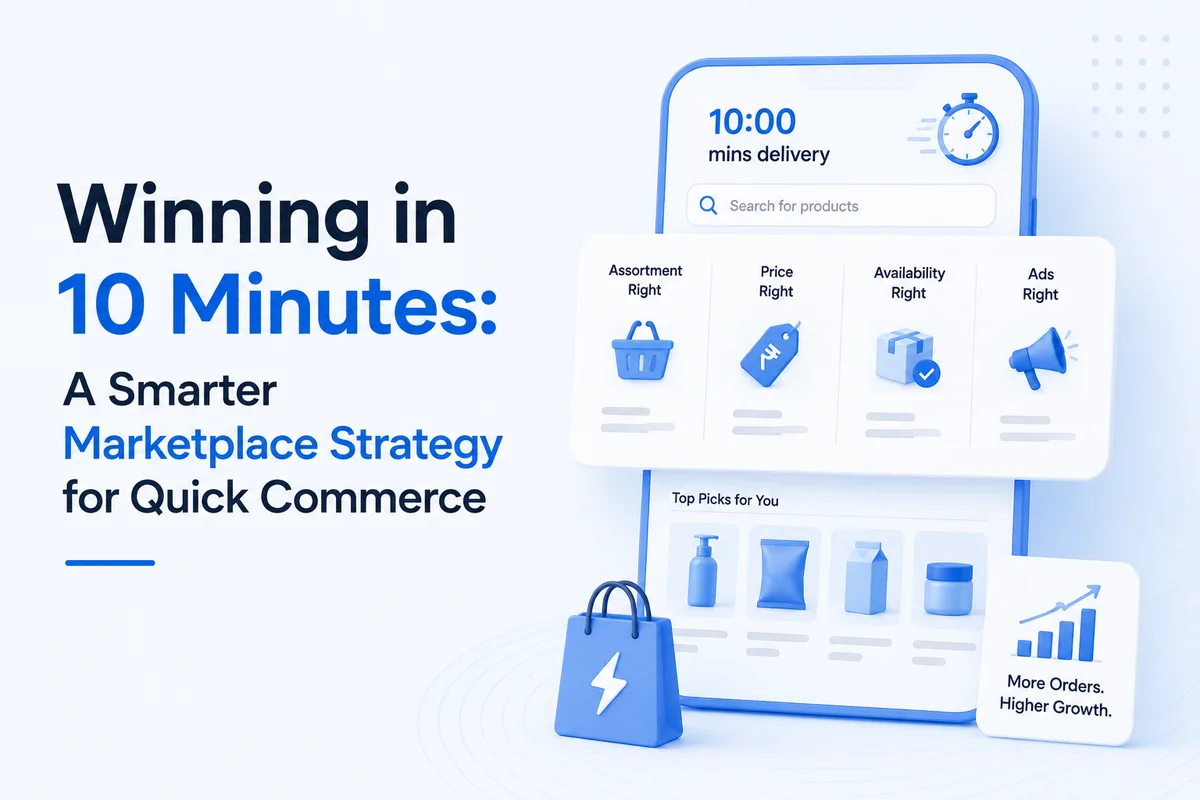
A smarter quick commerce marketplace strategy optimizes SKU performance zone by zone and uses micro-experiments to improve discoverability. Quick commerce in India has become a hyperlocal, algorithm-driven marketplace, so national averages hide where you win and where you lose. This is for brands selling on Blinkit, Zepto, Instamart and Flipkart Minutes that want SKU, stock and visibility decisions made by pincode.
How has competition changed in quick commerce?
The landscape has shifted dramatically. Blinkit handled 110.3 million orders in October–December 2024 alone (Zomato shareholders’ letter, 2025), and Zepto reached a $5B valuation in August 2024 on the promise of 10-minute delivery (Inc42, 2024). Scale like that has changed what brands are competing for.
You’re not just fighting for shelf space; you’re fighting for fulfillment speed within hyperlocal delivery zones. Traditional brand equity matters less than three things: SKU availability in high-performing dark stores, add-to-cart rates and conversion velocity.
| What traditional retail rewards | What quick commerce rewards |
|---|---|
| Shelf space | What quick commerce rewardsFulfillment speed within hyperlocal delivery zones |
| Brand equity | What quick commerce rewardsSKU availability in high-performing dark stores, add-to-cart rates and conversion velocity |
| Performance against national averages | What quick commerce rewardsZone-specific, hyperlocal performance |
| City-level tracking | What quick commerce rewardsPincode-level tracking |
Four moves follow from that shift: redefining SKU health, mapping discoverability, fixing weighted availability and running micro-experiments.
How should you measure SKU health in a 10-minute world?
Performance metrics have to shift from national averages to hyperlocal context. Revenue and impression data alone won’t tell you whether a SKU is healthy where it matters. Focus instead on:
- Zone-specific add-to-cart percentages, which show whether shoppers in a given area want the product once they see it.
- Repeat rates, which show whether they come back for it.
- Stocking levels in the highest-throughput dark stores, where the most orders flow through.
Then copy what’s working. Use your top-performing SKUs as blueprints for underperforming variants: update tags, adjust time slots and refine pricing based on the attributes of the products that succeed. If one variant converts well under certain tags and at certain hours, its weaker sibling may simply be missing the same context.
Check this in your account: For one city, compare a SKU’s add-to-cart rate and repeat rate zone by zone, instead of its national average.
How do you map discoverability at pincode level?
Quick commerce interfaces show only a handful of product slots per screen. A SKU that doesn’t make those slots is effectively invisible, and invisible SKUs are ineffective regardless of inventory strength. Stock in the dark store does nothing if the shopper never sees the tile.
Tracking must happen at pincode level rather than city level. Algorithms respond to local demand, dark store availability and app behavior within the small area each dark store serves, typically a 2–3 km radius (Inc42, 2025), so the same SKU can sit on the first screen in one pincode and out of sight in the next.
A discoverability audit answers three questions for each SKU:
- Where does it surface? Which pincodes, and in which slots.
- Under which tags? The keywords and categories it appears for.
- During which hours? What shoppers see can differ through the day.
The answers point to conversion gaps, places where a SKU is stocked but not seen. They also make keyword strategy more efficient, because you can target the tags and hours where a SKU is missing rather than bidding everywhere.
Check this in your account: Search your main keywords in several pincodes at different hours, and record whether your SKU appears on the first screen.
What is weighted availability, and why does it matter?
Most brands measure availability nationally, which misses critical context: a handful of high-velocity stores can drive a large share of city revenue. A national availability figure can look healthy while the stores that matter most are out of stock.
“Weighted availability” fixes that blind spot. It measures whether priority SKUs remain consistently stocked in top-performing stores during peak demand windows. Two checks make it practical:
- Out-of-stock gaps during high-traffic hours, such as the morning rush: on Swiggy Instamart, most carts are filled between 7 and 11 a.m. (Swiggy, 2025). A stockout in those hours hits the peak demand window directly.
- Inventory lag between warehouse and dark store, the delay between stock existing in the network and stock sitting on the shelf where shoppers order.
Weighted availability changes the question from “are we in stock?” to “are we in stock where, and when, it counts?”
Check this in your account: List the dark stores that drive most of your city revenue, then check your priority SKUs’ stock there during peak hours.
How can micro-experiments revive underperforming SKUs?
Underperforming SKUs often suffer from poor context rather than weak demand. The product may be fine; it’s being shown in the wrong place, for the wrong search or at the wrong time. Micro-experiments help reposition it. Test:
- Localised placement, in specific zones rather than across the whole city.
- Contextual keywords that match how shoppers search for the occasion.
- Neighborhood targeting, focusing on the areas most likely to respond.
- Timing around peak consumption hours.
A 72-hour test enables algorithms to learn appropriate product positioning and revive struggling SKUs. Keep each experiment narrow, change one thing at a time, and compare the SKU’s add-to-cart rate and conversion before and after, so you know which change did the work.
In q-commerce, you’re not just selling a product. You’re selling momentum — per pincode, per minute.
For the location side of this strategy, the dark store playbook for SKU performance by location goes store by store, and planning by micromarket explains how to target neighborhoods rather than whole cities. ShelfRadar’s inventory, promo and ad solutions for quick commerce cover the same ground, from stock health and DRR to ad spend.
Frequently asked questions
What is a quick commerce marketplace strategy?
It is a plan for winning on hyperlocal, algorithm-driven platforms by optimizing SKU performance zone by zone. It covers SKU health in hyperlocal context, discoverability at pincode level, weighted availability in top dark stores and micro-experiments that revive underperforming SKUs.
What is weighted availability in quick commerce?
Weighted availability measures whether priority SKUs remain consistently stocked in top-performing stores during peak demand windows. It matters because a handful of high-velocity stores can drive a large share of city revenue, which national availability figures miss.
Why track quick commerce visibility by pincode instead of city?
Algorithms respond to local demand, dark store availability and app behavior within the small area each dark store serves, and interfaces show only a handful of product slots per screen. A SKU can be visible in one pincode and invisible in the next, regardless of inventory strength.