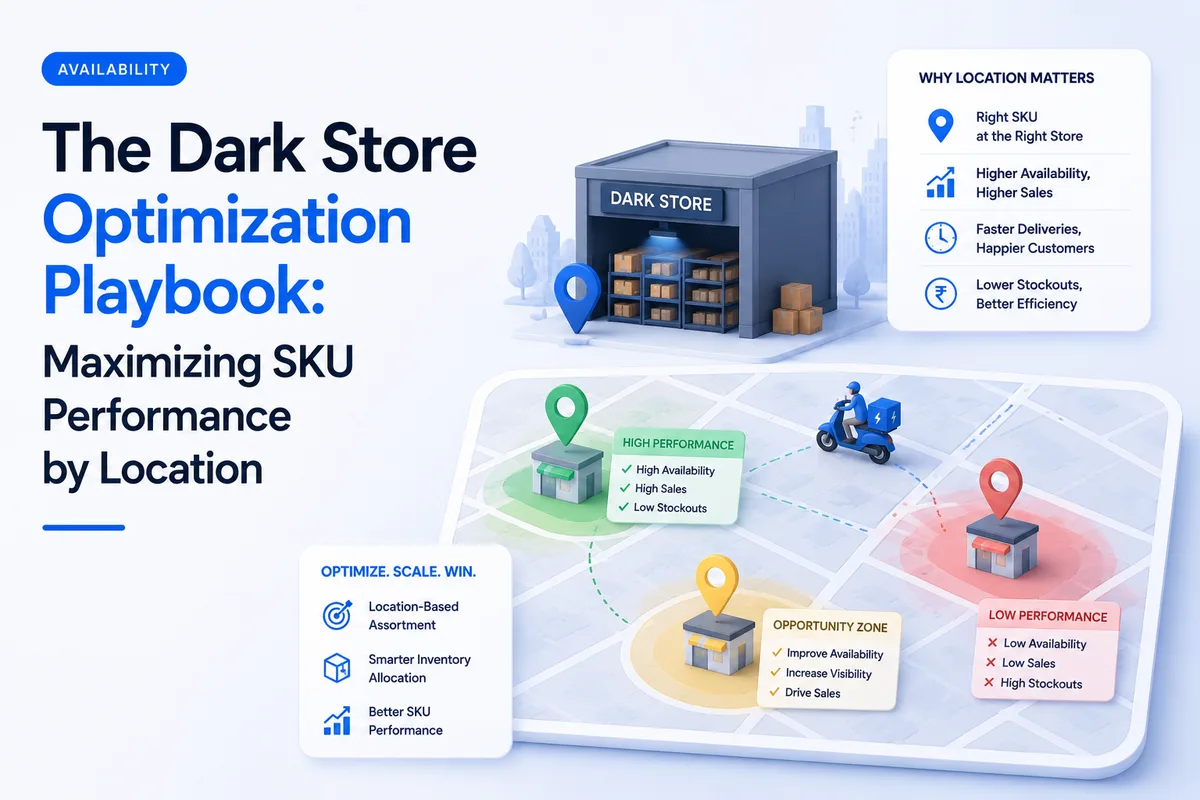
Dark store optimization means managing each SKU’s availability, competition and search visibility store by store. In quick commerce, product success depends on hyperlocal performance across hundreds of dark stores rather than brand strength alone, so national averages hide most of what matters. It is for brands selling on Blinkit, Zepto, Swiggy Instamart and Flipkart Minutes that want every location to pull its weight.
Why does SKU performance change from one dark store to the next?
Traditional retail relies on broad market assumptions. Quick commerce requires precision at the pincode level, because its platforms operate inventory models that are distinctly different from traditional e-commerce.
Each dark store functions independently, with its own demand patterns, competitive landscape and consumer behavior. A SKU performing well in one location may be invisible in another because of localised algorithmic dynamics.
The scale makes this hard to manage by feel. Blinkit operated 2,751 dark stores across India at the end of September 2026 (Eternal Q2 FY27 shareholders’ letter, October 2026), each serving a small area, typically a 2–3 km radius (Inc42, 2025), with distinct demographic profiles and purchase patterns. Brand visibility in each micromarket depends on location-specific factors that are rarely surfaced in platform dashboards.
Dark store optimization rests on three pillars, covered in the sections that follow:
- Weighted availability: putting stock where store performance and local demand are strongest.
- Micromarket competitive intelligence: knowing who you compete with in each store.
- Algorithmic shelf engineering: earning visibility through strong local performance.
Check this in your account: Pick one SKU and compare its search rank in pincodes served by different dark stores in the same city.
What is weighted availability, and how should you tier dark stores?
Weighted availability means judging stock by store performance and local demand intensity rather than by overall platform availability. A SKU can look well stocked across a platform and still be missing in the stores where it sells most, and those are the gaps that cost the most sales.
Volume is rarely spread evenly across dark stores, and the stores that carry the most of it deserve premium inventory allocation, faster restocking and dedicated account management. The recommended tiered strategy looks like this:
| Tier | Which stores | Inventory approach |
|---|---|---|
| Tier 1 | Which storesTop 20% by volume | Inventory approach7-day inventory buffers |
| Tier 2 | Which storesNext 30% | Inventory approach5-day buffers |
| Remaining stores | Which storesEverything below Tier 2 | Inventory approach3-day cycles |
The tiers match effort to stakes. Because Tier 1 stores carry the most volume, a stockout there loses far more sales than one in a low-volume store, so Tier 1 gets the deepest buffer and the fastest restocking. The remaining stores run on shorter cycles, so stock isn’t parked where it moves slowly.
Check this in your account: Rank your dark stores in one city by volume, then check how many days of stock your best sellers hold in the top-ranked stores.
How do you track the competition around each dark store?
Each dark store operates within its own competitive ecosystem. The brand you fight for the top tile in one store may barely appear in the next, so a single national competitor list tells you little about any particular store.
For your top 50 stores, identify the three competing SKUs in your category and analyze:
- Pricing strategies: how they price against you in that store.
- Promotional frequencies: how often they run offers there.
- Shelf positioning patterns: where they tend to appear when shoppers browse and search.
This micromarket competitive intelligence shows you where to defend, where to respond to a rival’s price or offer, and where a competitor’s weak spot leaves room to grow. It also feeds the competitive response protocols in the roadmap below.
How do quick commerce algorithms decide which SKUs get visibility?
Quick commerce platforms use sophisticated algorithms that weigh location-specific factors, including:
- Historical performance
- Inventory levels
- Customer preferences
- Competitive dynamics
The result is a velocity feedback loop. Platforms prioritize SKUs with strong local performance metrics, and that visibility creates compounding advantages for the SKUs that already perform. The same factors cut the other way: inventory levels and historical performance are judged store by store, so a store where you sell slowly or run short is a store where visibility is harder to earn.
Algorithmic shelf engineering means using that loop on purpose through strategic launch sequencing:
- Begin with 10–15 high-potential stores.
- Build strong local performance metrics there.
- Expand to similar demographic clusters before scaling further.
Sequencing builds algorithmic credibility before scaling: the SKU gets the best possible start in a few stores before it reaches the stores that look like them.
What does a dark store optimization roadmap look like?
The playbook runs in three phases.
Weeks 1–2: data foundation
- Extract location-wise performance data from platform dashboards.
- Identify the top 20% performing dark stores by volume and conversion.
- Map the competitive landscape for each priority location.
Weeks 3–4: strategy development
- Implement weighted inventory allocation.
- Develop location-specific pricing strategies.
- Create micromarket competitive response protocols.
Weeks 5–8: execution and optimization
- Launch the phased expansion strategy.
- Monitor location-specific performance metrics.
- Iterate based on algorithmic response patterns.
Each phase feeds the next: the store ranking sets your tiers, and the phased expansion follows the launch sequencing described above.
Which KPIs show whether dark store optimization is working?
Success requires moving beyond aggregate metrics to location-specific KPIs. A national average can look healthy while your most important stores slip.
| KPI | What it measures | What it tells you |
|---|---|---|
| Store-level market share | What it measuresCategory share within each dark store | What it tells youWhether you are winning each store, not just the city |
| Velocity index | What it measuresSales per day per store compared with the category average | What it tells youWhether your DRR (daily run rate) in a store beats or trails the category there |
| Algorithmic visibility | What it measuresAverage ranking across key search words by location | What it tells youWhether shoppers in each location can find you |
Read together, the three show the velocity feedback loop at work: visibility drives sales, sales lift share, and strong local performance feeds back into visibility.
Check this in your account: Compare each store’s daily sales of your hero SKU with the category average for that store, and list the stores where you trail.
Brands mastering dark store optimization create sustainable competitive advantages by building location-specific moats that are difficult to replicate. In quick commerce, geography becomes strategy rather than destiny.
To plan ads, assortment and stock neighborhood by neighborhood, read our micromarkets strategy for quick commerce. For how weighted availability fits a wider pincode-level plan, see a smarter marketplace strategy for quick commerce. ShelfRadar’s inventory, promo and ad solutions for quick commerce brands track every SKU in every dark store, so availability, competitor moves and search ranks can be managed location by location.
Frequently asked questions
What is dark store optimization?
It is managing each SKU’s availability, competition and search visibility store by store. In quick commerce, product success depends on hyperlocal performance across hundreds of dark stores rather than brand strength alone, and each dark store has its own demand patterns, competitive landscape and consumer behavior.
How much inventory buffer should each dark store hold?
Weight it by volume. Volume is rarely spread evenly across dark stores, so a tiered strategy gives Tier 1 stores (top 20% by volume) 7-day inventory buffers, Tier 2 stores (next 30%) 5-day buffers and the remaining stores 3-day cycles.
How should a brand launch a SKU across dark stores?
Sequence it. Begin with 10–15 high-potential stores, then expand to similar demographic clusters. Platforms prioritize SKUs with strong local performance metrics, so starting small builds algorithmic credibility before scaling.