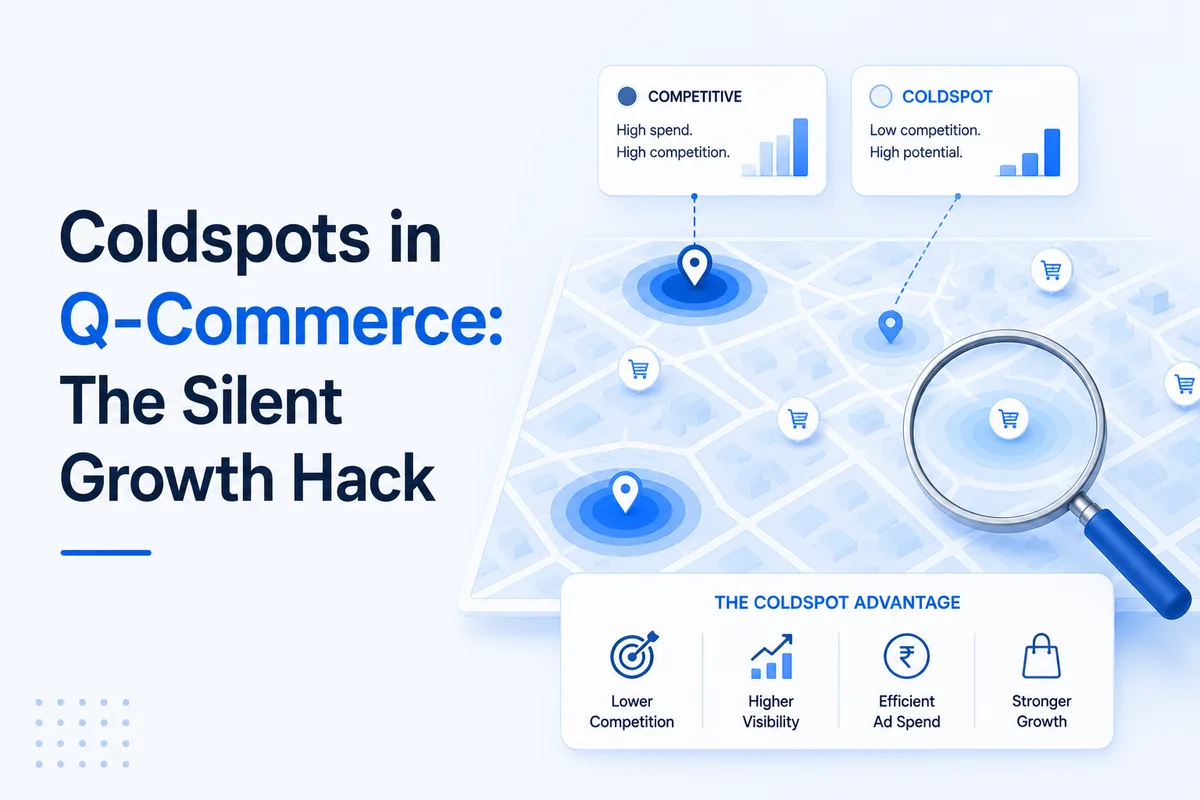
Coldspots in quick commerce are high-intent searches that stay underserved because of poor visibility, not a lack of demand. While established brands fight over saturated keywords, these quiet pockets reward precision targeting over volume. This is for brands advertising on Blinkit, Zepto, Instamart and Flipkart Minutes that want growth without paying more and more just to stay visible.
What are coldspots in quick commerce?
Established brands compete aggressively in saturated keyword spaces. Meanwhile, numerous high-intent searches remain underserved, and the reason is poor visibility rather than lack of demand. Shoppers are searching; the right products just aren’t showing up for them.
These “coldspots” are silent growth opportunities. In a coldspot, precision targeting outperforms volume-based strategies, because you aren’t trying to outbid the category leader on the biggest keyword. You’re answering a specific search that is currently underserved.
The idea is easy to misread as “find the searches nobody makes”. It’s the opposite. Coldspots aren’t empty. They’re quiet, and in digital retail, silence is a white space waiting to be activated.
What does a coldspot look like on Blinkit?
Take a fitness-focused professional searching for “low calorie snacks” on Blinkit. Instead of aligned options like Yoga Bar or Max Protein, they see irrelevant legacy products.
That’s a discovery bottleneck rather than a demand deficit. The demand is there: someone typed a specific, high-intent query. The problem is what happens next:
- The shopper sees products that don’t match what they asked for.
- The algorithm fails to register strong conversion signals for that search.
- The visibility gap deepens, because nothing tells the platform which products belong there.
For a brand whose product genuinely fits the search, that gap is the opening. The fit that is missing from the results is exactly what that brand can supply.
Check this in your account: Search your most specific product keywords on each app in a few pincodes, and note which brands appear before yours.
What are red zones, and why do they drain ad budgets?
Red zones are the opposite of coldspots: expensive, low-return competitive spaces that brands get trapped in. Three factors keep them there.
- SKU proliferation dilutes discovery. Too many similar products, such as a long list of near-identical peanut butter variants, overwhelm shoppers and confuse algorithmic ranking systems. More listings don’t mean more visibility when they all look alike.
- Bidding burnout drains ROI. Keywords like “high protein” trigger escalating CPMs, where brands pay more just to stay visible, not to grow. That traps them in costly acquisition cycles.
- Sponsored cannibalisation. Brands appear in sponsored and organic rankings at the same time, bidding against themselves and paying for organic traffic.
Here is how the two kinds of search compare:
| Red zone | Coldspot | |
|---|---|---|
| Competition | Red zoneSaturated keyword space, many similar SKUs | ColdspotFewer than 3 competing category players visible per scroll |
| Ads | Red zoneEscalating CPMs on keywords like “high protein” | ColdspotMinimal sponsored or curated content placement |
| Search type | Red zoneCrowded, contested keywords | ColdspotHigh-specificity queries indicating strong intent |
| What your spend buys | Red zoneStaying visible, sometimes your own organic traffic | ColdspotVisibility on underserved, high-intent searches |
Check this in your account: Find the keywords where you hold both a sponsored and an organic position, and check how much you pay for those clicks.
How do you recognize a coldspot?
Coldspots share a recognizable set of characteristics:
- Fewer than 3 competing category players visible per scroll.
- Minimal sponsored or curated content placement.
- High-specificity user queries that indicate strong intent, like “low calorie snacks” rather than a broad category term.
- Concentration in high-income urban areas, such as Bangalore, Mumbai and Gurgaon.
- Underutilization by brands focused on Amazon SEO, which tend to assume their Amazon optimization will carry over.
Each one is a signal on its own. Together they describe a search where demand exists, competition is thin and the shopper knows what they want.
How do you use the C.A.L.M. framework to find coldspots?
C.A.L.M. is a structured approach to identifying overlooked opportunities. Work through the four letters for any search or category you’re considering:
| Letter | What to check | What to look for |
|---|---|---|
| C – Competitor Count | What to checkAudit category saturation | What to look forFewer than 2–3 high-relevance players, which signals opportunity |
| A – Ads Running | What to checkAnalyze ad density versus keyword specificity | What to look forSpecific searches served by poorly matched ads |
| L – Local Fit | What to checkHyperlocal demand signals, such as fitness culture and income distribution, across tier-1 cities | What to look forAreas where those signals fit what your product offers |
| M – Marketplace Coverage | What to checkAudit SKU presence and product descriptions | What to look forGaps in presence, and descriptions written for Amazon rather than quick commerce |
The ads check is the subtle one. When ad density is high but the ads don’t match a specific query well, the problem is poor semantic matching, and a product that truly fits the query has room to stand out.
The marketplace check matters because Amazon optimization doesn’t automatically transfer. Product descriptions need to be optimized for quick commerce algorithms, not copied across from another marketplace and assumed to work.
Check this in your account: Compare your quick commerce product descriptions with your Amazon listings, and rewrite any that were copied across unchanged.
Why does segmentation beat saturation?
Red zones reward whoever can keep paying to stay visible. Coldspots reward whoever fits the search. Brands that shift focus from saturation to segmentation won’t just win clicks. They’ll win habits. Meaningful growth comes from serving underserved demand rather than competing in congested spaces.
Coldspots are often local, so planning quick commerce by micromarket is a natural next step. If you’re already caught in sponsored cannibalisation, quick commerce ad ranking optimization shows how to stop paid and organic listings competing. ShelfRadar’s ad solutions for quick commerce brands include per-keyword keep, cut, bid-up or pull recommendations, with decision authority staying with you.
Frequently asked questions
What is a coldspot in quick commerce?
A coldspot is a high-intent search that stays underserved because of poor visibility rather than lack of demand. Coldspots typically show fewer than 3 competing category players per scroll, minimal sponsored content and highly specific queries, so precision targeting outperforms volume-based strategies.
How do you find coldspots on Blinkit or Zepto?
Use the C.A.L.M. framework: check Competitor Count (fewer than 2–3 high-relevance players), Ads Running (ad density versus keyword specificity), Local Fit (hyperlocal demand signals across tier-1 cities) and Marketplace Coverage (SKU presence and descriptions optimized for quick commerce, not carried over from Amazon).
What are red zones in quick commerce advertising?
Red zones are expensive, low-return competitive spaces. Brands get trapped by SKU proliferation, such as a long list of near-identical peanut butter variants, by bidding burnout on keywords like “high protein” where CPMs keep escalating, and by sponsored cannibalisation, where they bid against their own organic listings.