
Qcom Growth

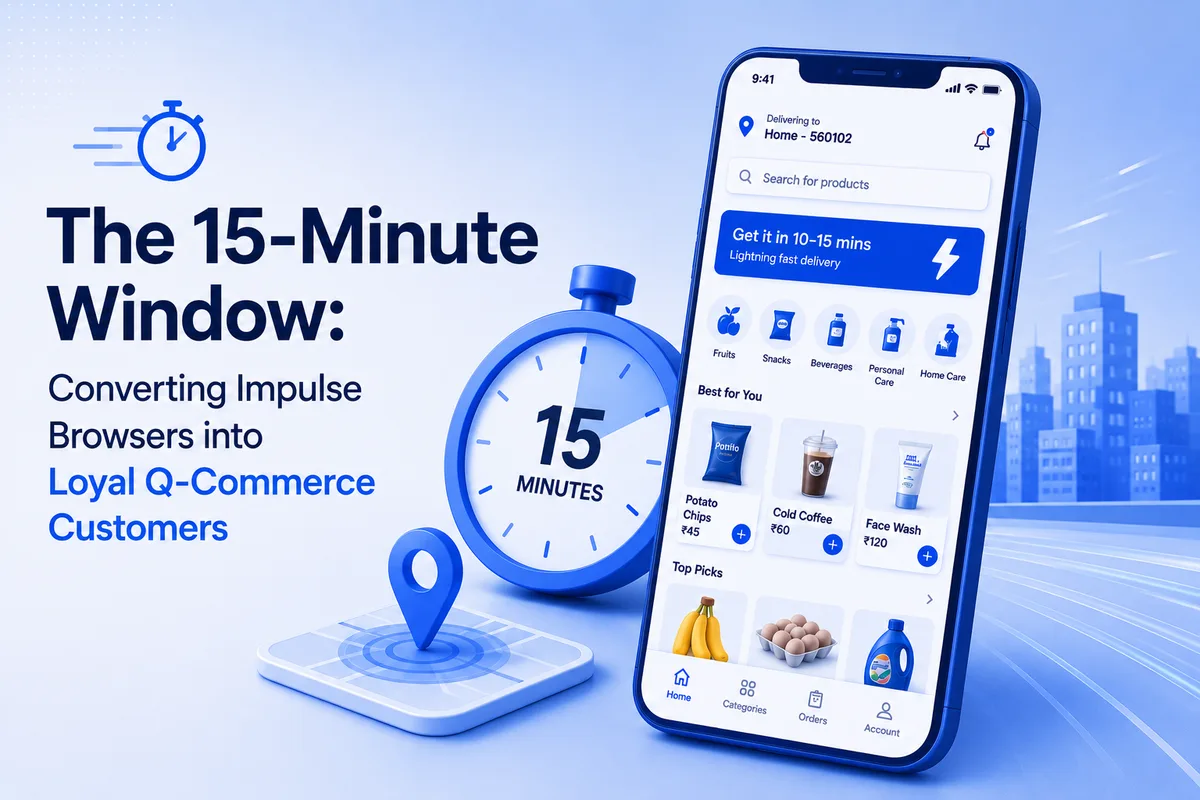
The 15-Minute Window: Converting Impulse Browsers into Loyal Q-Commerce Customers

Quick commerce algorithm optimization

In quick commerce, customer acquisition happens in micro-moments. Unlike traditional e-commerce where customers deliberate over purchases, Q-commerce operates in a compressed decision-making environment where impulse browsing can instantly convert to loyal customer relationships, if brands understand the psychology of the 15-minute window.

Quick commerce creates a unique behavioral paradox: customers arrive with immediate needs but low brand loyalty, yet the speed and convenience of fulfillment can create stronger retention than traditional channels. The challenge lies in converting spontaneous, need-driven purchases into habitual, preference-driven behavior within a single transaction cycle.

Research indicates that Q-commerce customers make purchase decisions faster than traditional e-commerce shoppers, but their lifetime value potential is also significantly higher when properly converted. The key is recognizing that impulse browsers aren't just seeking products, they're seeking solutions to immediate problems.

The Conversion Triggers

  1. Problem-Solution Velocity
    Impulse browsers arrive with urgent needs: late-night snacks, forgotten ingredients, emergency supplies. The fastest path to conversion isn't product features, it's immediate problem resolution. Brands must position products as instant solutions rather than considered purchases. Optimize product titles and descriptions for problem-solving rather than feature-listing. "Instant noodles" converts better than "premium korean ramen" for impulse browsers at 11 PM.

  2. Cognitive Load Reduction
    The 15-minute window demands minimal cognitive effort. Impulse browsers won't compare specifications or read detailed reviews. They need instant confidence in their choice through social proof, clear value propositions, and simplified decision-making. Use high-contrast ratings, clear "bestseller" badges, and simplified product variants. Every additional choice point reduces conversion probability in quick commerce environments.

  3. Immediate Gratification Amplification
    Quick commerce's core promise is speed, but smart brands amplify this with emotional gratification. The anticipation of immediate delivery should feel rewarding, not just convenient. Celebrate it, “Delivered before your tea cools,” “Your midnight snack is already on its way.” By linking convenience with delight, brands make gratification memorable, not mechanical.

The Loyalty Bridge Strategy
Converting impulse purchases into loyal relationships requires building bridges between immediate satisfaction and future value. This happens through three sequential touchpoints:

Moment 1: Delivery Excellence
The physical delivery experience becomes your first brand impression. Packaging quality, delivery speed accuracy, and product condition directly influence repeat purchase probability.

Moment 2: Packaging Hooks for Engagement
Instead of relying on platform-owned channels, brands must use packaging to invite customers into their own ecosystem. This could be QR codes leading to recipes, cashback offers on a brand microsite, or inserts offering discounts on the next purchase on their website. The goal is to give impulse buyers a reason to voluntarily connect with the brand beyond the Q-commerce platform.

Moment 3: Habit Formation
Once customers have opted in through these hooks, brands can activate post-purchase engagement strategies. Contextual nudges, personalized reminders, or loyalty rewards can then build recurring behavior. Packaging acts as the bridge, without it, customers remain anonymous; with it, they can transition into addressable audiences.

The Measurement Framework
Moving from anecdotal wins to a repeatable strategy requires measurable guardrails. Brands can’t just celebrate conversions, they need to know if those conversions translate into sustainable value. Three metrics form the backbone of impulse-to-loyalty measurement:

  1. 30-Day Repeat Purchase Rate
    What it is: The percentage of customers who make at least one more purchase within 30 days of their first impulse-driven order.
    Why it matters: Q-commerce is built on immediacy. If a customer doesn’t return within 30 days, they’re unlikely to become habitual users.
    How to track: Segment customers by acquisition type (discount-driven, emergency-driven, convenience-driven) and monitor their return behavior.
    What to do with it: If repeat rates are low, refine your post-purchase engagement, consider tighter replenishment nudges and contextual offers.

  2. Customer Lifetime Value (CLV) Progression by Acquisition Type
    What it is: The projected revenue a customer will generate over their relationship with the brand, broken down by how they were acquired.
    Why it matters: Not all impulse customers are equal. Some arrive for discounts and churn quickly, while others, if nurtured, can evolve into high-value loyalists.
    How to track: Tag acquisition sources (flash sales, app notifications, search ads, word-of-mouth). Compare CLV curves by source.
    What to do with it: Shift budgets toward acquisition types that produce stickier customers. For example, customers acquired via “need-based” ads (e.g., “Running out of milk?”) may deliver higher CLV than those acquired with blanket discounting.

The Competitive Advantage
Brands mastering impulse-to-loyalty conversion create sustainable competitive moats. While competitors focus on acquisition costs, optimized brands build customer lifetime value from the first interaction. The result isn't just improved unit economics, it's market leadership through customer retention. The insight driving this strategy: In quick commerce, loyalty isn't built over time, it's engineered in moments. The brands that understand this fundamental shift from relationship-building to moment-optimization will dominate the next phase of India's retail evolution. In the 15-minute economy, every impulse purchase is a loyalty opportunity waiting to be unlocked.

Related Articles

Related Articles

Try ShelfRadar.ai for free

Claim an early spot in ShelfRadar’s beta program for our 30 day challenge! We will drive Rs. 1L in savings within 30 days either through improved availability, pricing, ad or cost optimization.

Try ShelfRadar.ai for free

Claim an early spot in ShelfRadar’s beta program for our 30 day challenge! We will drive Rs. 1L in savings within 30 days either through improved availability, pricing, ad or cost optimization.

Try ShelfRadar.ai
for free

Claim an early spot in ShelfRadar’s beta program for our 30 day challenge! We will drive Rs. 1L in savings within 30 days either through improved availability, pricing, ad or cost optimization.

ShelfRadar is an AI product backed by Punt Partners that provides brand owners a decision co-pilot leveraging cutting edge data & algorithms to optimize brand outcomes in the fast changing quick commerce landscape.

Led by founders with deep expertise in marketing technology and backed by leading Indian internet founders, ShelfRadar is in private beta from October 2025.

© 2026 ShelfRadar. All rights reserved.

ShelfRadar is an AI product backed by Punt Partners that provides brand owners a decision co-pilot leveraging cutting edge data & algorithms to optimize brand outcomes in the fast changing quick commerce landscape.

Led by founders with deep expertise in marketing technology and backed by leading Indian internet founders, ShelfRadar is in private beta from October 2025.

© 2026 ShelfRadar. All rights reserved.

ShelfRadar is an AI product backed by Punt Partners that provides brand owners a decision co-pilot leveraging cutting edge data & algorithms to optimize brand outcomes in the fast changing quick commerce landscape.

Led by founders with deep expertise in marketing technology and backed by leading Indian internet founders, ShelfRadar is in private beta from October 2025.

© 2026 ShelfRadar. All rights reserved.