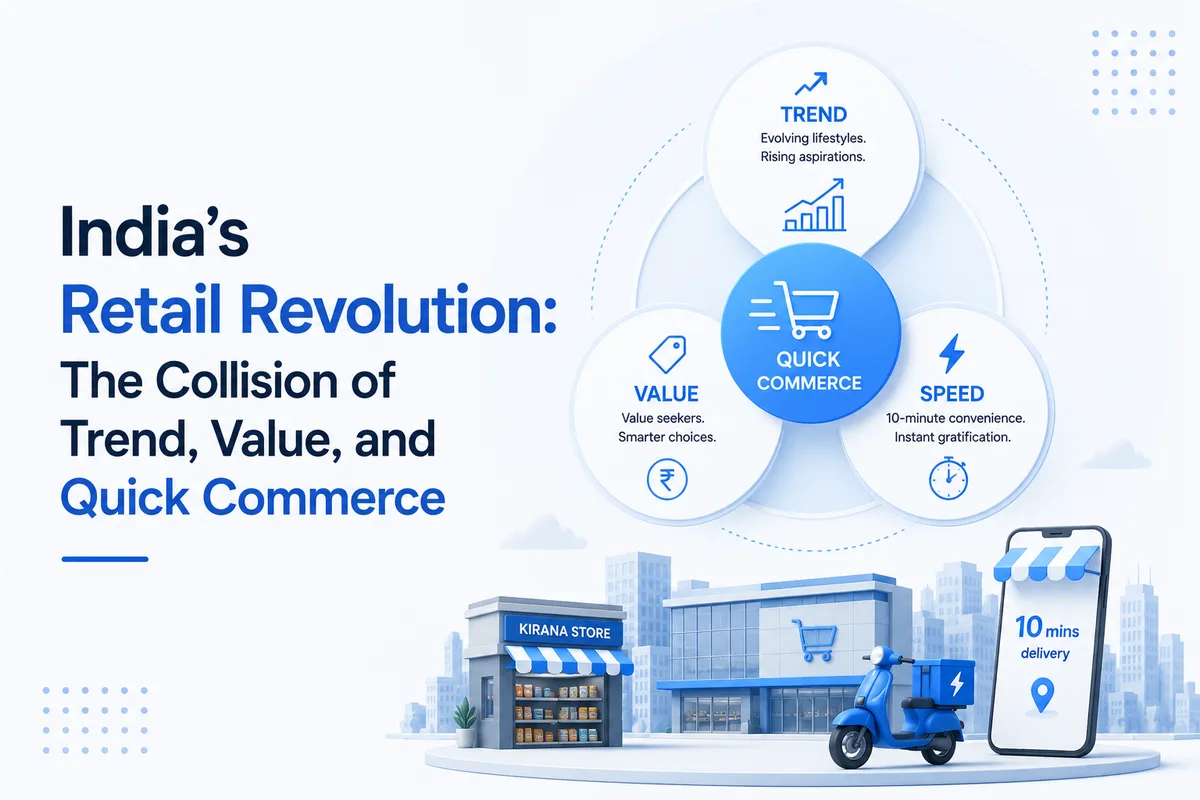
The future of quick commerce in India depends on more than fast delivery. Growth will come from platforms and brands that make Q-com a place to discover products and feel good about value, not just a faster way to buy essentials. This is for brands selling on Blinkit, Zepto, Instamart and Flipkart Minutes, planning beyond 10-minute delivery.
Where is quick commerce in India heading?
Quick commerce in India is changing fast, but staying power takes more than speed. The sector projects 40% year-over-year growth through 2030. The challenge that comes with that growth is identity: Q-com has to become more than a rapid delivery mechanism.
Speed is the promise. What keeps shoppers opening the apps, and what makes them try something new there, is a different question. The answer this post argues for is a collision of two forces: trend, which creates the reason to browse, and value, which creates the reason to buy.
Check this in your account: Look at how many of your quick commerce orders come from shoppers buying your product for the first time.
Why isn’t speed enough to win?
Today’s quick commerce experience is functional. People order essentials like toiletries or instant noodles, and the app does exactly what it promises. But it lacks emotional engagement.
If speed is the only reason to open the app, shoppers come back for the same short list of products, and brands end up competing for the same few searches with the same few SKUs.
The opportunity is in what the experience is missing: anticipation, novelty and the feeling that the app is worth opening even when you don’t need anything urgent.
How can quick commerce become a discovery channel?
Successful Q-com platforms will have to evolve from transactional utilities into discovery engines. Trend-driven commerce works because of psychological connection and anticipation. Seasonal events like Amazon Prime Day or Nykaa Pink Friday show how much demand a moment can create when shoppers look forward to it.
Platforms can borrow that playbook. Instead of relying only on speed and convenience, they can introduce:
- Curated collections that give shoppers a reason to browse.
- Celebrity partnerships that bring a story and an audience with them.
- Trend-responsive offerings, such as Diwali specialty boxes, weekly self-care kits and cricket-season flash events.
For brands, discovery happens on a very small canvas. Because of how the Q-com interface works, the packaging, name or value proposition has to demand attention within milliseconds of being seen. A product that needs explaining loses to one that is understood at a glance.
What does value mean to quick commerce shoppers in India?
Value is the second force. Hyper-value commerce shows that Indian consumers respond to psychological pricing mechanics, the “₹99 magic” effect, rather than to absolute low prices. A price that feels right can matter more than a price that is lowest.
Current Q-com pricing structures create perception problems, particularly in tier-2+ cities, where delivery fees can outweigh the cost of the products themselves. When the fee dominates the basket, even a good price on the product feels like poor value.
For brands, this changes how to think about price points and pack sizes:
| What shoppers respond to | What it means for brands |
|---|---|
| Psychological price points like ₹99 | What it means for brandsDesign packs and bundles to land on prices that feel right |
| Fees that feel out of proportion to the basket | What it means for brandsBuild baskets and bundles that make the order feel worth it |
| Moments to look forward to | What it means for brandsPlan limited editions and seasonal packs around trend moments |
Check this in your account: Compare typical basket values in your category with delivery fees in metros and smaller cities, to see where an order can feel like poor value.
What should brands do now to prepare?
The brands and platforms that win the next phase of Indian quick commerce won’t just be the fastest. They’ll be the ones that make discovery feel as good as delivery. A practical starting list:
- Make the product readable in a glance. Packaging, name and value proposition have to work within milliseconds on a small tile.
- Plan around trend moments. Festivals, seasons and cricket-season events are reasons to browse; have products and packs ready for them.
- Price for perception, not just margin. Test the price points and pack sizes that feel like value, especially outside the metros.
- Think in collections, not single SKUs. Curated kits and specialty boxes give shoppers a reason to try something new.
- Watch what each city responds to. Value and trends don’t land the same way everywhere; our post on micromarkets in quick commerce covers how to plan by neighborhood.
For what could come next, voice commerce meets quick delivery looks at preparing for the next shopping shift, and ShelfRadar’s solutions for quick commerce brands show how inventory, promos and ads can be planned around these moments.
Check this in your account: Compare sales of your last seasonal or trend-led pack with your core SKU over the same weeks.
Frequently asked questions
What is the future of quick commerce in India?
The sector projects 40% year-over-year growth through 2030, but growth depends on Q-com becoming more than a rapid delivery mechanism. The next phase favors platforms and brands that combine discovery, trend-led offerings and value with speed.
Why isn’t fast delivery enough for quick commerce?
Today’s experience is functional: shoppers order essentials like toiletries or instant noodles, but it lacks emotional engagement. Trend-driven commerce relies on anticipation, which is why events like Amazon Prime Day or Nykaa Pink Friday create demand that speed alone doesn’t.
How do Indian shoppers judge value on quick commerce?
They respond to psychological price points, the “₹99 magic” effect, more than to absolute low prices. In tier-2+ cities, delivery fees that are large relative to the products in the basket can make an order feel like poor value.