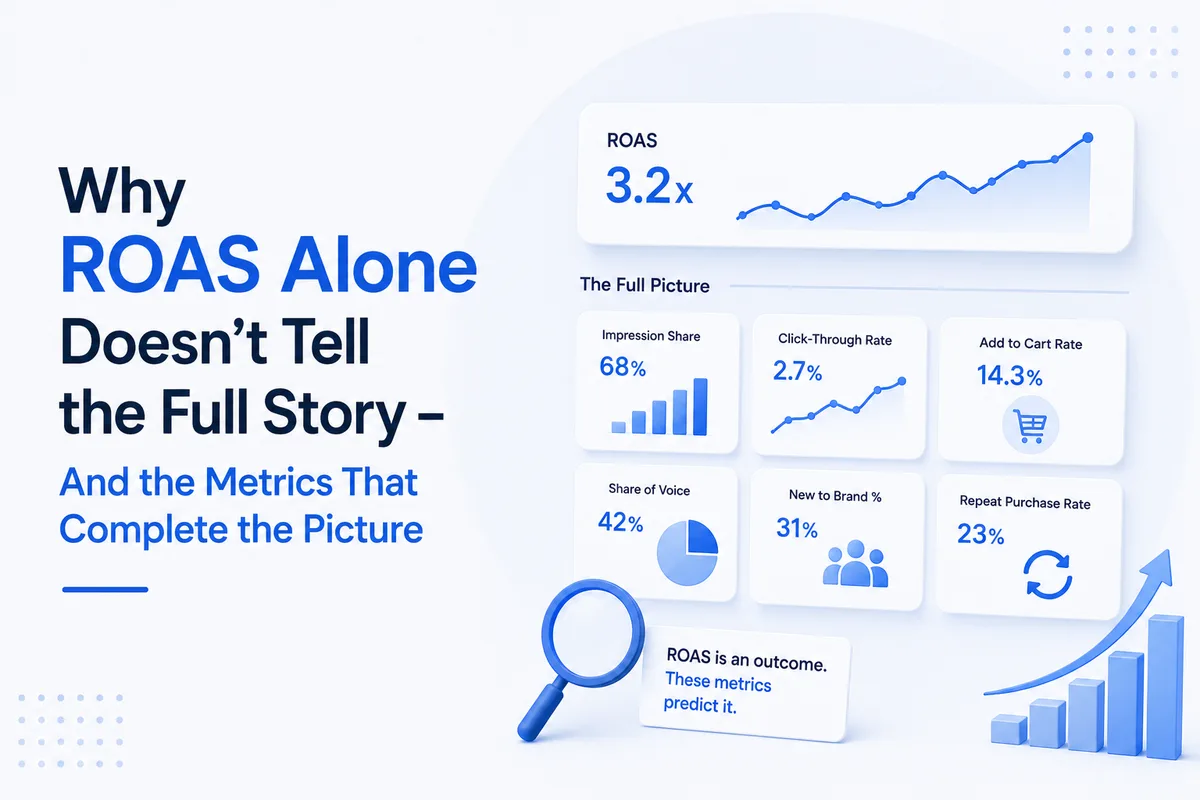
ROAS optimization in quick commerce means treating return on ad spend as one output among several, not the whole scoreboard. ROAS measures efficiency, but it hides the missed opportunities and visibility gaps that hold back D2C brands on Blinkit and Zepto. Five diagnostic metrics complete the picture: impression share by daypart, CTR, add-to-cart rate, cart-to-purchase conversion and category share of voice.
Why isn’t ROAS enough to grow on quick commerce?
Return on Ad Spend (ROAS) is a standard performance metric, and it is useful: it tells you how much revenue your ads returned for what you spent. But it gives an incomplete perspective for quick commerce scaling.
ROAS is inherently backward-looking. It measures efficiency, not opportunity, and fails to reveal where expansion potential exists. A campaign can post a strong ROAS while showing up in only a few moments of the day or for a narrow slice of shoppers, and nothing in that number tells you what it missed. For D2C brands on platforms like Blinkit or Zepto, those missed opportunities and visibility gaps are what constrain growth.
So the useful question isn’t “is my ROAS good?” It’s “what is my ROAS not showing me?”
Check this in your account: Take your highest-ROAS campaign and check how much of your category’s relevant search traffic it actually appears for.
Which metrics should you track alongside ROAS?
Five diagnostic metrics complete the picture. Each answers a question ROAS can’t:
| Metric | What it tells you | What a strong ROAS can hide |
|---|---|---|
| Impression share per SKU × daypart | What it tells youVisibility gaps across time periods | What a strong ROAS can hideImpressions bunched into one part of the day |
| Click-through rate (CTR) | What it tells youRelevance and creative resonance | What a strong ROAS can hideMost shoppers bypassing your ads |
| Add-to-cart rate (ATC) | What it tells youPre-purchase interest | What a strong ROAS can hideCheckout friction that stops interested shoppers |
| ATC-to-purchase conversion rate | What it tells youFinal-stage leakage | What a strong ROAS can hideCart abandonment caused by platform friction |
| Category share of voice (SOV) | What it tells youPresence in relevant impressions | What a strong ROAS can hideMissing broader market exposure |
Read them together, not one at a time. On its own, each is just another number on a dashboard. Paired with ROAS, each one shows whether the efficiency is real or the sign of a campaign that only reaches a small part of its market.
How do you find visibility gaps by daypart?
Impression share per SKU × daypart identifies visibility gaps across time periods. It breaks your exposure down by product and by time of day, so you can see when each SKU is actually being shown.
This is where a strong ROAS can mislead most directly. A strong ROAS might mask that most impressions concentrate in morning hours while evening demand remains underexposed. The campaign looks efficient because it converts well in the hours it runs, but it is barely present when evening shoppers are buying.
Fixing that doesn’t have to mean spending more. It can mean rebalancing budget across dayparts so that evening demand gets the exposure it is currently missing.
Check this in your account: Break one SKU’s impressions down by daypart and see whether evening hours get the exposure that morning hours do.
What do CTR and add-to-cart rate reveal that ROAS doesn’t?
Click-through rate (CTR) signals relevance and creative resonance: whether the shoppers who see your ad find it worth tapping. Low CTR with high ROAS indicates narrow conversion among visible audiences while most shoppers bypass ads. The few who click buy, which keeps ROAS high, but most shoppers who see the ad scroll past it.
Add-to-cart rate (ATC) reveals pre-purchase interest. High ATC with low conversions typically indicates checkout friction, with hidden costs inflating the final price substantially. A protein bar’s final price can climb well above its shelf price once handling and delivery fees and free-shipping thresholds are added, creating conversion fatigue in quick commerce’s short purchase windows.
That example is worth a closer look. The shopper wanted the product enough to add it to the cart. What stopped them was the final price, not the ad or the product. More ad spend won’t fix that; the place to look is how the price builds up between the product page and checkout.
Where do shoppers drop off between cart and purchase?
The ATC-to-purchase conversion rate isolates final-stage leakage: shoppers who added your product but didn’t complete the order. Every cart abandonment flags platform friction points like payment failures or fulfillment zone limitations.
Some of these causes sit with the platform rather than the brand, but they still change how you should read your numbers. If a SKU’s carts regularly fail to convert in certain zones, the issue may be fulfillment rather than demand, and pushing more ad spend into those zones won’t change the outcome.
Check this in your account: Compare add-to-cart and purchase counts for your top SKUs zone by zone, and flag places where carts rarely become orders.
How does share of voice change the ROAS picture?
Category share of voice (SOV) measures your presence in relevant impressions: of the impressions that matter in your category, how many are yours. Strong ROAS combined with low SOV suggests efficiency in visible moments while missing broader market exposure. You’re winning the moments you show up for and absent from the rest.
That is the pattern behind all five metrics. Each pairing has its own warning sign:
- Strong ROAS, impressions bunched into mornings: evening demand remains underexposed.
- High ROAS, low CTR: narrow conversion among visible audiences, while most shoppers bypass the ads.
- High ATC, low conversions: checkout friction, such as hidden costs inflating the final price.
- Carts that don’t become orders: platform friction, such as payment failures or fulfillment zone limitations.
- Strong ROAS, low SOV: efficiency in visible moments, while missing broader market exposure.
Smart teams use ROAS as an output measurement and use these diagnostic inputs for deeper understanding, treating ROAS as one signal among five, not the whole scoreboard.
For more on the numbers that predict growth, see the hidden metrics beyond CTR in quick commerce. To keep ROAS honest when paid and organic listings overlap, read quick commerce ad ranking optimization. ShelfRadar’s ad solutions for quick commerce brands include daypart-level ROAS visibility, with decision authority staying with you.
Frequently asked questions
Is ROAS a good metric for quick commerce ads?
ROAS is a standard performance metric, but it gives an incomplete picture for quick commerce scaling. It is backward-looking and measures efficiency, not opportunity, so it can hide missed opportunities and visibility gaps on platforms like Blinkit or Zepto.
What should you track besides ROAS in quick commerce?
Five diagnostic metrics: impression share per SKU × daypart, click-through rate, add-to-cart rate, ATC-to-purchase conversion rate and category share of voice. Use ROAS as an output measurement and these as the inputs that explain it.
Why do shoppers add to cart but not buy on quick commerce?
High add-to-cart with low conversions typically points to checkout friction. Hidden costs inflate the final price: handling and delivery fees and free-shipping thresholds can push a protein bar well above its shelf price. Payment failures and fulfillment zone limitations also cause cart abandonment.