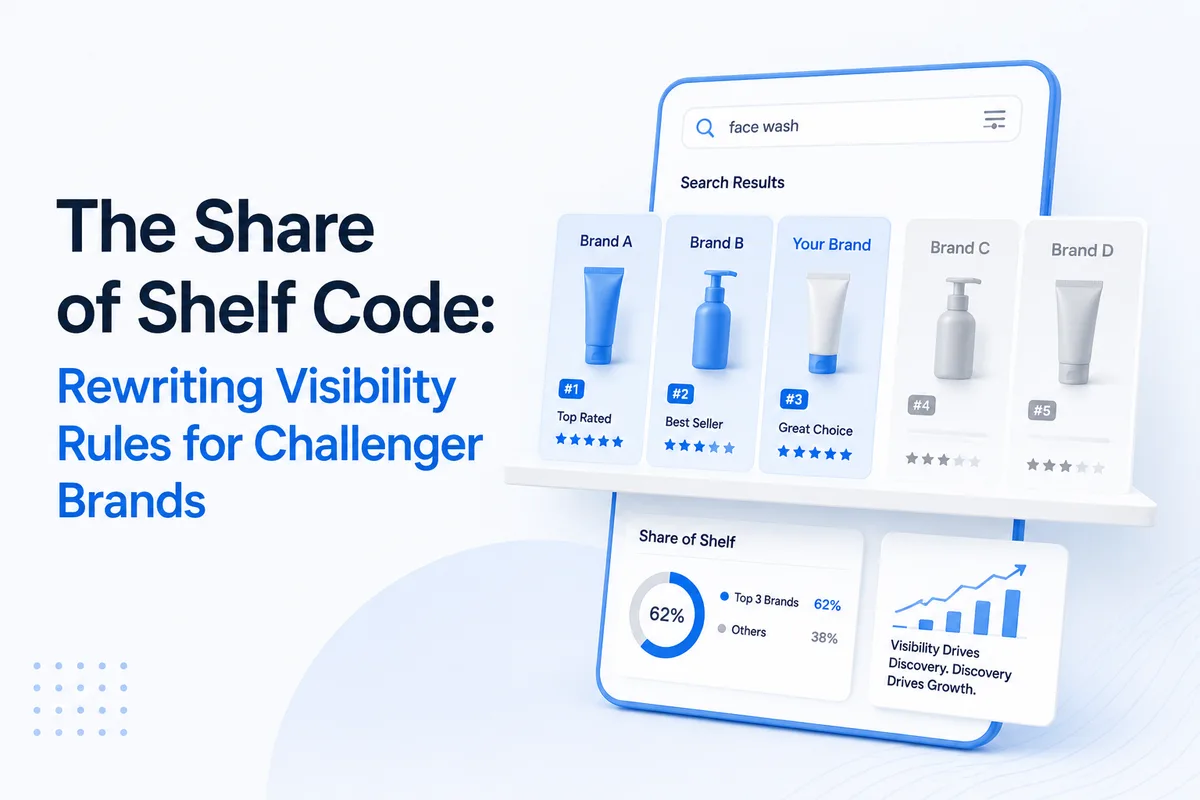
Share of shelf in quick commerce is how much of the screen your products own when shoppers search: the positions, the searches and the locations where you appear. It is for challenger brands selling on Blinkit, Zepto, Instamart and Flipkart Minutes that can’t outspend category leaders and need precision instead of scale.
What is share of shelf in quick commerce?
Visibility in quick commerce has shifted from physical distribution to algorithmic discovery. On a quick commerce app, share of shelf is decided by search: which products appear, in what order, for which searches, in which locations.
That makes share of shelf something a brand can engineer, not just buy. The rules are different from traditional retail, and they reward brands that understand how discovery works on these platforms. As this post argues, the shelf is now volatile, algorithmic and programmable.
Check this in your account: For your main category, note which brands hold the first-screen positions in each pincode of one city, and where your products appear.
Why do legacy brands dominate quick commerce search?
Legacy brands currently start ahead, through larger assortments and deeper budgets. Established players like Nescafé dominate search through:
- Intent-driven SKU architecture: a product for most of the ways shoppers search.
- Algorithmically optimized metadata: listings written to match how the platform reads them.
- Platform-level performance signals: the engagement and sales history that keep them ranking.
Emerging brands face the opposite: limited SKU lineups, smaller ad budgets and weaker engagement metrics. So challenger brands need precision tactics rather than scale-based competition.
How can challenger brands win share of shelf?
There are four levers, and they work best together:
| Lever | What to do | Example |
|---|---|---|
| Micro-intent mapping | What to doTarget specific searches instead of broad ones | Example“protein chips”, “healthy evening snack”, “guilt-free snack” instead of “chips” |
| Geo-fenced growth loops | What to doConcentrate stock and ads where you already have regional presence | ExampleFocus supply and budgets on one region first |
| Strategic SKU architecture | What to doDesign each listing for a consumer segment, not just a flavor | ExampleA post-workout protein chip, a late-night craving pack, a tiffin-safe mini pack |
| Time-synced promotion bursts | What to doRun offers and ads in low-competition hours | ExampleOff-peak windows such as 3–5 PM and after 10 PM |
Micro-intent mapping. Rather than competing for “chips”, target the specific searches a challenger can own. Back them up with benefit-focused product descriptions (“perfect for post-workout snacking”) and intent-rich metadata tags (“low calorie”, “keto snack”, “school snack”).
Geo-fenced growth loops. Concentrate inventory and advertising budgets in the hyperlocal markets where you already have regional presence. Concentrated sales trigger algorithmic visibility boosts, which create self-reinforcing growth cycles.
Strategic SKU architecture. Design each listing for a specific consumer segment rather than as another flavor variation: a post-workout protein chip for fitness-conscious shoppers, a late-night craving pack for comfort-food moments, a tiffin-safe mini pack for parents searching for school snacks. Each one expands your algorithmic surface area across more intent categories.
Time-synced promotion bursts. Use off-peak hours, 3–5 PM and after 10 PM, for limited-time discounts and low-competition ad bursts that train the algorithms toward prioritizing you later.
What does this look like for a challenger snack brand?
Take a hypothetical snack brand, Crav’d. Instead of launching a long range, it launches three precision-engineered SKUs:
- Sriracha Baked Chips, for spicy healthy-snack searches
- Low-Calorie 100-Cal Packs, for diet-friendly snacks
- After-School Snack Mix, for healthy school snacks
It geo-locks supply to NCR and runs targeted guilt-free-snacking campaigns there. The result: Crav’d gains organic ranking without competing on SKU volume.
Check this in your account: After a geo-fenced launch, track your rank on each micro-intent keyword week by week in the pincodes you focused on.
How do you track share of shelf over time?
Because the shelf is volatile, share of shelf has to be watched, not set once. A few signals tell you whether the levers are working:
- Rank on your micro-intent searches, by pincode, so you can see where you own the first screen and where you don’t.
- Share of voice (SoV) against the category leaders on the searches that matter to you.
- Stock and DRR (daily run rate) in the dark stores where you run growth loops, so visibility never runs ahead of supply.
- ROAS on promotion bursts, so off-peak offers earn their place.
Ranking also depends on how your ads and organic listings work together; quick commerce ad ranking optimization covers how to stop paid and organic positions cannibalizing each other. For the search side, see how to improve quick commerce search rankings ethically.
Success requires signal engineering, category adjacency and growth-loop design: thinking like search strategists and D2C growth operators rather than following traditional retail playbooks. ShelfRadar’s solutions for quick commerce brands track visibility, stock and ads together by location to support exactly that.
Frequently asked questions
What is share of shelf in quick commerce?
It is how much of the screen your products own in search on apps like Blinkit, Zepto and Instamart. Visibility has shifted from physical distribution to algorithmic discovery, so share of shelf depends on which searches, positions and locations your products appear in.
How can a small brand compete with big brands on quick commerce?
Compete on precision rather than scale: map micro-intent searches like “protein chips” instead of “chips”, concentrate stock and ads in markets where you have regional presence, design SKUs for specific consumer segments, and run promotion bursts in off-peak hours like 3–5 PM and after 10 PM.
Why do brands like Nescafé rank so well on quick commerce?
Established players dominate search through intent-driven SKU architecture, algorithmically optimized metadata and platform-level performance signals, helped by larger assortments and deeper budgets.