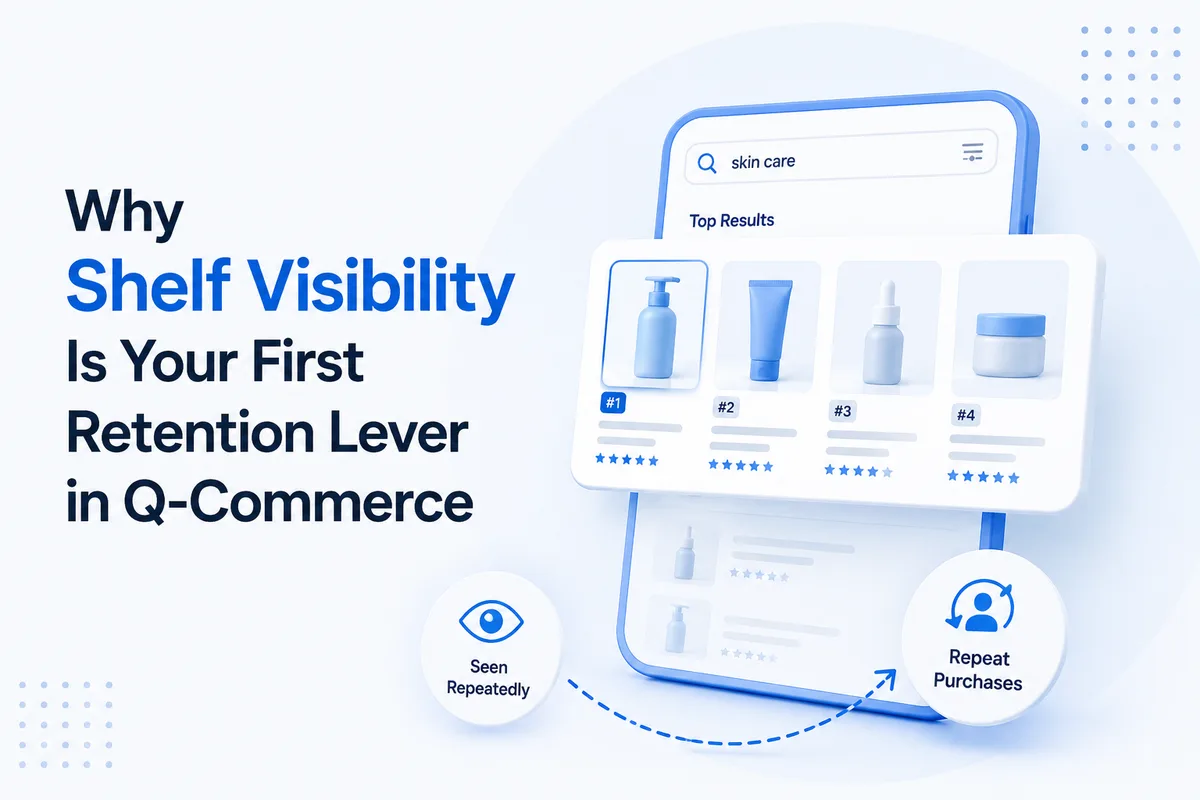
Shelf visibility is the first retention lever in quick commerce because shoppers rebuy what they keep seeing. Sessions last seconds, and products outside the prime placements never enter the shopper’s memory, so retention starts on the shelf, not after the purchase. This is for brands selling on Blinkit, Zepto, Instamart and Flipkart Minutes that want repeat buyers, not one-off orders.
Why is shelf visibility a retention lever in quick commerce?
In quick commerce, the retention playbook has fundamentally shifted. Retention is usually treated as a post-purchase challenge: win the first order, then work on bringing the customer back. Quick commerce doesn’t give you that much room. Visibility itself is the most powerful retention lever, because decisions happen within compressed windows and shoppers reach for what they have already seen.
On a quick commerce app, the next purchase happens on the same screen as the first one: in a search result or a scroll. If your product sits in the same prime position each time, the shopper learns where to find it. If it doesn’t, the habit never gets the chance to form.
| Retention as a post-purchase job | Retention as visibility | |
|---|---|---|
| Where it’s won | Retention as a post-purchase jobAfter the first order | Retention as visibilityOn the shelf, in every session |
| What counts as the KPI | Retention as a post-purchase jobOutputs like CTR and conversion rate | Retention as visibilityDrivers like OSOS rates and search appearance frequency |
| What builds the habit | Retention as a post-purchase jobBringing the shopper back | Retention as visibilityBeing in the same place every time they look |
What happens in a quick commerce shopping session?
Quick commerce platforms compress shopping into short sessions, and most conversions occur early in the scroll sequence. Shoppers aren’t wandering the aisles; they open the app, find what they need and check out.
That compression changes what it costs to be missing. Products absent from those prime placements face not just conversion loss but cognitive erasure: they never enter consumer memory. A shopper who doesn’t see you today has no reason to think of you tomorrow, or to search for you by name.
So the question isn’t only “did we get the sale?” It’s “were we seen, early, in the place the shopper looked?”
Check this in your account: For your top keywords, check whether your product appears on the first screen in each key pincode, not just somewhere in the results.
How do brands earn top tile placement?
Tile placement isn’t static. It’s algorithmically earned, through metrics that include:
- Add-to-cart rates: how often shoppers who see the tile add the product.
- Conversion velocity: how quickly views of the product turn into orders.
- Stock reliability: whether the product is consistently in stock where shoppers order.
- Category-level performance deltas: how the product performs compared with the rest of its category.
Each of these is something a brand can work on, and they feed each other. A product that stays in stock keeps converting, and a product that keeps converting holds on to its tile.
Akshayakalpa Organic Milk shows what that looks like over time. Consistent top placement across platforms builds default choice status without heavy promotional spending. When shoppers find the same milk in the same place every time, choosing it stops being a decision and becomes a default.
Which metrics show whether visibility is building a habit?
Metrics like CTR and conversion rate are outputs, not drivers. They tell you what happened after a shopper saw your product, but not whether shoppers saw it reliably enough to form a habit.
To measure habit formation potential, track two things instead:
- On-Shelf Out-of-Stock (OSOS) rates: how often your product is listed but out of stock on the shelf a shopper sees. Every out-of-stock moment breaks the pattern of finding you in the same place.
- Search appearance frequency: how often your product appears for the searches that matter in your category. Appearing sometimes is not the same as appearing every time.
These are the drivers. When they improve, the outputs, CTR and conversion, have more to work with.
Check this in your account: Track, week by week, how often each hero SKU is out of stock in your key dark stores and how often it appears in search.
How do keywords decide which purchase occasions you show up for?
Keywords function as context gatekeepers. They decide not just whether you’re visible, but which purchase occasions you’re relevant to. A shopper searching for breakfast is in a different moment from one looking for something high-protein, even if your product fits both.
A muesli brand, for example, should position itself across breakfast, high-protein and health-conscious categories rather than a single placement. Each occasion is a separate shelf, and each one is another chance to be seen in the same place by the same shopper.
Check this in your account: List the searches your product appears for, then note the purchase occasions your category serves where it doesn’t appear at all.
What should brands do differently?
Treat visibility as the retention plan, not a step before it. In practice:
- Protect first-screen placement on your most important searches, pincode by pincode.
- Keep stock reliable in the dark stores where you rank, so out-of-stocks don’t break the habit.
- Track drivers, not just outputs: OSOS rates and search appearance frequency alongside CTR and conversion.
- Cover every purchase occasion your product genuinely serves, through keywords.
If a customer never sees you in the same place twice, they never learn to look for you at all. Visibility isn’t the top of the funnel in quick commerce — it’s the whole funnel.
Repeat purchase is its own puzzle in a channel built on speed; the quick commerce retention paradox covers the metrics that predict it. For winning visibility as a smaller brand, see share of shelf for challenger brands. ShelfRadar’s inventory, promo and ad solutions for quick commerce look at stock and ads together, by location.
Frequently asked questions
How does shelf visibility affect retention in quick commerce?
Quick commerce compresses shopping into short sessions where most conversions happen early in the scroll. Products missing from prime placements never enter consumer memory, so consistent visibility, not post-purchase effort, is the first retention lever.
What is OSOS in quick commerce?
OSOS stands for On-Shelf Out-of-Stock. The OSOS rate tracks how often a product is listed but out of stock on the shelf shoppers see. Along with search appearance frequency, it is a driver for measuring habit formation potential, while CTR and conversion rate are outputs.
How do quick commerce platforms decide tile placement?
Tile placement is earned algorithmically, through metrics including add-to-cart rates, conversion velocity, stock reliability and category-level performance deltas. Consistent top placement, as with Akshayakalpa Organic Milk, builds default choice status without heavy promotional spending.